

I’ve always preferred warm summers to chilly winters, but as the years go by, I’ve noticed that colder weather affects me more than it used to, both physically and mentally. My biggest issue is simple but incredibly frustrating – cold hands and feet. They can ruin a cozy evening, and on bad nights, it feels impossible to fall asleep when my feet are basically two ice blocks.
After trying all the usual tricks, I eventually found something that actually helped: essential oils. With the right blend, my hands and feet warm up faster, I relax more easily, and winter becomes a bit more manageable.
In this post, I want to share what I’ve learned. How cold hands and feet happen, why certain oils help, and the blends I use regularly. If you’re someone who struggles with the same problem, you might find this surprisingly useful.
Why do hands and feet get cold in the first place
Cold hands and feet are incredibly common, and in most cases, they’re not a sign of anything serious. It usually comes down to a simple reaction in the body: the tiny blood vessels in your fingers and toes tighten. When these vessels narrow, warm blood can’t reach the skin as easily, and your hands and feet cool down fast.
Remember:
- Narrower vessels = less warm blood reaching the skin.
- Less blood flow = cold hands and feet.
This happens because the vessel walls contain smooth muscle, which contracts when you’re cold or stressed. It’s your body’s way of conserving heat by pulling blood toward the core.
But for some of us, these muscles are a little overactive, and they tighten too easily or stay tight for too long.
This can happen when you’re:
- exposed to cold,
- stressed or overwhelmed,
- sitting still for long periods,
- tired or sleep-deprived.
So the problem isn’t just the weather. It’s also your circulation and your autonomic nervous system, which controls things like heart rate and blood vessel tone.

How essential oils actually help with cold hands and feet
If cold hands and feet come from narrowed blood vessels, then the main goal is simple: help those small muscles in the vessel walls relax. And this is where essential oils can make a difference.
Several essential oils, and the natural chemical compounds inside them, have been shown to relax smooth muscle, including the smooth muscle that wraps around peripheral blood vessels. When these muscles loosen their grip, the vessels widen again in a process called vasodilation, and warmth returns more easily. This relaxing action is known as an antispasmodic effect.
Some essential oils can also influence the activity of L-type calcium channels
(professionally known as voltage-dependent Ca²⁺ channels). These channels help regulate whether the vessel walls stay tight or relaxed.
You don’t need the deep biochemistry here, but it’s worth knowing the practical idea:
- when these channels are very active → the vessels stay narrow
- when the channels calm down → the muscle relaxes
- relaxed muscle → wider vessel → better blood flow → warmer hands and feet
So essential oils don’t “heat up” your hands directly. Instead, they help the vessel walls let go of that tight, protective squeeze, which allows warm blood to return to the skin. The warmth comes from your own circulation working normally again, and the oils simply support the process.
This combination of antispasmodic action and improved vasodilation is why certain essential oils can genuinely help if you struggle with cold hands and feet.
Key aromatic compounds that support vessel relaxation
I genuinely believe that even a basic understanding of essential oil chemistry can make a huge difference in how we use them. It doesn’t have to be complicated, it simply gives you a helpful framework. When you know which aromatic compounds tend to create certain effects in the body, choosing oils becomes much more intuitive.
In the case of cold hands and feet, one of the actions we’re most interested in is how certain molecules can influence calcium channels in smooth muscle. When these channels quiet down, the vessel walls can relax more easily, which connects directly to what we talked about earlier: better flow, more warmth.
Below is a short list of key aromatic compounds that are known to support this kind of relaxation:
- Menthol – widely known for activating TRPM8 receptors (your skin’s “cold receptors”), which is why it feels icy at first (Oz et al., 2017). But underneath that sensory trick, menthol can also inhibit L-type Ca²⁺ channels and reduce calcium entry into smooth muscle (Amato, Liotta & Mulè, 2014; Oz et al., 2017). Once those muscles relax, the vessels widen, and that’s when the gentle warming effect can show up.
- (–)-Carvone – a strong smooth-muscle relaxant. Studies by Souza et al. (2013) show it can block L-type Ca²⁺ channels in models like guinea pig and bovine ileum, with effects compared to the pharmaceutical calcium-channel blocker verapamil, though on a much milder, natural scale.
- Citral – a natural mix of geranial and neral. Citral can reduce CaCl₂-induced contractions in smooth muscle, suggesting a calcium-blocking effect (Devi, Sim & Ismail, 2011). This aligns with the bright, loosening, almost “unwinding” sensation many people notice with citral-rich oils.
- Eugenol – a phenolic compound with clear antispasmodic activity. It relaxes smooth muscle (including ileum and aorta in research models) by inhibiting Ca²⁺ influx (Leal-Cardoso et al., 2002). It’s one of the more straightforward examples of calcium-related relaxation among essential oil constituents.
- Linalool – gentle, calming, and well-known. Linalool can modulate Ca²⁺ channels across several types of smooth muscle (Hashimoto, Takahashi & Ohta, 2023), contributing to both physical relaxation and that settling, balancing emotional effect people often feel with linalool-rich oils.
- 1,8-Cineole – works through a mix of pathways. It can influence Ca²⁺ channels, but also interacts with potassium channels and nitric oxide (Takaishi et al., 2012; Ventura-Martínez et al., 2011). Altogether, this supports vasodilation and microcirculation – one reason cineole-rich herbs are traditionally used for cold hands and feet.
- Geraniol – a monoterpene alcohol shown to inhibit both L-type and receptor-operated Ca²⁺ channels in vascular smooth muscle. By reducing calcium influx, it promotes vasorelaxation and helps counter excessive contractility (de Menezes-Filho et al., 2014; Gonçalves et al., 2025). This makes geraniol-rich oils unexpectedly helpful for supporting warmth and flow.
These compounds show up across so many different plant species that we end up with a wonderfully broad palette of essential oils to work with when supporting warmth and healthy circulation.
You don’t need to memorize every detail of their pharmacology, just having a general sense of the main categories already makes formulation so much easier. For example, if you know that linalool or 1,8-cineole can help relax smooth muscle, your brain will naturally make the connection:
“Right, Lavender has linalool, and Rosemary ct. cineole has 1,8-cineole… that could work nicely!”
And if you don’t have rosemary on hand? No problem. You can quickly reason your way to an alternative like Eucalyptus radiata, because it shares a similar chemistry and therapeutic profile.
See? Once you understand the pattern, essential oil selection becomes much more intuitive, and much more fun!
Essential oils that support warmth and circulation
Now that we’ve talked about the key aromatic compounds involved in vessel relaxation, let’s look at the essential oils that are actually practical to use when your hands or feet tend to feel cold. There are many oils that can help in different ways, but the ones below show up most consistently in research connected to smooth-muscle relaxation and healthy circulation.
I grouped them according to the major aromatic compound they’re known for. This way, the chemistry we covered earlier will start to click into place and feel a lot more useful in practice.
Just keep in mind: this isn’t an exhaustive list of every oil containing these molecules. Instead, I’ve highlighted the ones that are especially rich in a specific compound and most relevant for warming, circulation-supportive blends.
1. Menthol/mint cooling constituents
As the name suggests, the oils in this group come from the mint family. They’re known for their distinctive cooling sensation at first contact (with one small exception), but what matters most here is their ability to relax smooth muscle afterwards, which makes them surprisingly useful when you want to support warmth.
- Peppermint (Mentha × piperita) → menthol
- Cornmint (Mentha arvensis) → menthol
- Spearmint (Mentha spicata) → (–)-carvone
Menthol-rich oils like Peppermint and Cornmint activate the skin’s cold receptors, so they feel cold initially, but underneath that sensory trick, menthol helps calm calcium channels in smooth muscle. As those tiny muscles around your blood vessels relax, warmth can return more easily.
And then we have Spearmint, which is actually a really interesting exception. Unlike the other mints, it’s rich in (–)-carvone, a compound that offers similar smooth-muscle–relaxing benefits without the strong cooling effect. That’s why spearmint is a fantastic choice if you want the circulatory support of a mint, but prefer a softer aroma and a gentler feel on the skin.
2. Citral-rich oils
These oils tend to be bright, uplifting, and slightly “loosening” in the body. They carry that unmistakable lemony–citrus aroma and can offer beautiful skin benefits when used at the right dilution.
- Lemongrass (Cymbopogon citratus, C. flexuosus) → citral
- May Chang (Litsea cubeba) → citral
- Melissa (Melissa officinalis) → partly citral + other synergistic compounds
The most classic examples here are the two types of Lemongrass: West Indian (C. citratus) and East Indian (C. flexuosus). They’re wonderfully effective, but their aroma can be… well, controversial. Many people associate Lemongrass aroma with mosquito repellents (you’re not alone, I’m not the biggest fan either).
If that’s you, May Chang is a fantastic alternative. It’s still citral-rich, but the scent is much more refined, elegant, and perfumery. Think “lemon sherbet” rather than “citronella candle.” Another option is Melissa, which is fragrant, soft, and beautifully complex. Because it’s rarer and pricier, I usually recommend using it sparingly, almost symbolically, but even a tiny amount can elevate a blend.
3. Geraniol/citronellol-rich oils
Essential oils in this category tend to be soft, harmonising, and wonderfully supportive when you want both emotional and physical ease. Their chemistry leans into gentle smooth-muscle relaxation, and aromatically they bring a sense of cohesion to almost any blend.
- Palmarosa (Cymbopogon martinii) → geraniol
- Geranium (Pelargonium graveolens) → geraniol + citronellol
I’ll be honest, Palmarosa is a must-have in my personal blends. I adore every facet of it: the rosy sweetness, the herbal undertone, the delicate freshness. It brings a kind of soft structure and fluidity that works beautifully in warming blends, especially when paired with warm herbs or mints.
Geranium is also a lovely option, but it has a different personality. Where Palmarosa is silky and floral-herbal, Geranium leans greener and more leafy. It’s balancing, uplifting, and has that unmistakable “classic aromatherapy” feel. If Palmarosa is the soft rose of the group, Geranium is the bright green foliage surrounding it.
Both oils add harmony and roundness, making them great connectors in a formula, especially when you’re working with sharper citrus notes or stronger herbs.
4. Linalool-rich oils
Oils rich in linalool are usually calming, balancing, and beautifully versatile. They have gentle smooth-muscle–relaxing properties, but what makes them especially valuable in warming blends is how well they support and soften the overall aroma.
- Coriander seed (Coriandrum sativum) → linalool
- Ho leaf (Cinnamomum camphora ct. linalool) → linalool
- True Lavender (Lavandula angustifolia) → linalool, linalyl acetate
Coriander seed is subtle, sweet, and quietly comforting. It doesn’t dominate the blend; it just smooths everything together and adds a soft warmth that works beautifully with herbs, mints, and spices. Ho leaf is another lovely source of linalool, and offers a clean, slightly woody floral note that feels calm and steady. And of course, True Lavender – classic, versatile, and instantly recognizable. Its chemistry also contributes to physical ease, making it a great choice when you want to soften the edges of a blend, “lift” heavier herb, or make bright citrus notes feel more refined.
5. 1,8-cineole-rich oils
Oils high in 1,8-cineole tend to feel fresh, herbal, and clarifying. Chemically, they work through mixed pathways, not only influencing calcium channels, but also supporting nitric oxide signaling and general vascular openness.
- Rosemary (Salvia rosmarinus ct. cineole) → 1,8-cineole
- Cardamom (Elettaria cardamomum) → cineole as a major component
- Sweet Basil (Ocimum basilicum) → often contains cineole + other monoterpenes
- Eucalyptus species (E. radiata, E. globulus, and E. smithii) → rich in 1,8-cineole
Rosemary ct. cineole is a classic in this category, traditionally used for cold hands and feet, and one of the most reliable oils when you want to gently stimulate circulation and mental clarity at the same time. Another interesting oil is Cardamom, which brings a softer and slightly sweet warmth. Even though it’s cineole-rich, it feels less sharp and penetrating than Rosemary or Eucalyptus, and blends fabulously with floral, herbal, and citrus oils.
Basil is a little more complex, because it has a few chemotypes that can contain cineole along with other monoterpenes that make it smell brighter and more aromatic. And of course, Eucalyptus. Whether you choose radiata, globulus, or smithii, these oils are consistently high in 1,8-cineole. They’re refreshing, clearing, and can offer some circulatory support, especially when rosemary isn’t available.
6. Warm antispasmodic herbal oils
This is probably the hardest category to explain, because the oils here aren’t dominated by one single molecule from our earlier chemistry list, yet they still show reliable antispasmodic and smooth-muscle–relaxing effects. Think of them as warm helpers.
- Marjoram (Origanum majorana) → terpinen-4-ol, linalool derivatives
- Dill seed (Anethum graveolens) → carvone-type profile but softer
Marjoram is a beautiful example of a functional essential oil. Its chemistry is a gentle mix of terpinen-4-ol and some linalool derivatives, giving it that classic warm, comforting, slightly sweet herbal note. It’s also one of the most reliable oils for easing tension in the body.
And Dill seed is a bit more unusual. Its main compounds include (+)-limonene and (+)-carvone, which is the mirror-image form of the (–)-carvone found in spearmint. These enantiomers share structural similarities, but behave differently aromatically and therapeutically: Spearmint’s (–)-carvone is sweet, minty, smooth, and Dill’s (+)-carvone is warm, spicy, reminiscent of caraway seeds. Even though it doesn’t behave exactly like spearmint chemically, dill seed fits beautifully into warming blends.
7. Eugenol-rich oils
These oils are potent, extremely effective, and very well-documented in terms of their smooth-muscle–relaxing activity, but they are rarely practical for topical warming blends. Their dermal limits are extremely low, and they can easily irritate the skin if overused. In most cases, it’s safer to either avoid them topically or use them in very small amounts and with good dilution practices.
- Cinnamon leaf (Cinnamomum verum, leaf) → eugenol
- Clove bud/leaf (Syzygium aromaticum) → eugenol
- Pimento bud/leaf (Pimenta dioica) → eugenol
During my clinical aromatherapy training, I was taught that eugenol-rich oils can be justified in certain therapeutic situations when the risk–benefit ratio makes sense, but those are usually very specific and targeted applications. For everyday, general-use warming blends, I personally don’t recommend relying on them. It’s more about understanding that the option exists, rather than making it your go-to.
That said, these oils can be gorgeous additions to blends intended mainly for inhalation or for creating a specific aromatic mood. Used sparingly, they contribute depth, warmth, and that characteristic spicy–sweet roundness. My personal favorite here is Pimento bud (Pimenta dioica), which has a beautiful, soft spiciness with clove-like and peppery nuances. If I were to use any oil from this category, it would be this one, but always in tiny amounts – it can add a refined, perfumery finish to a blend without overwhelming it.
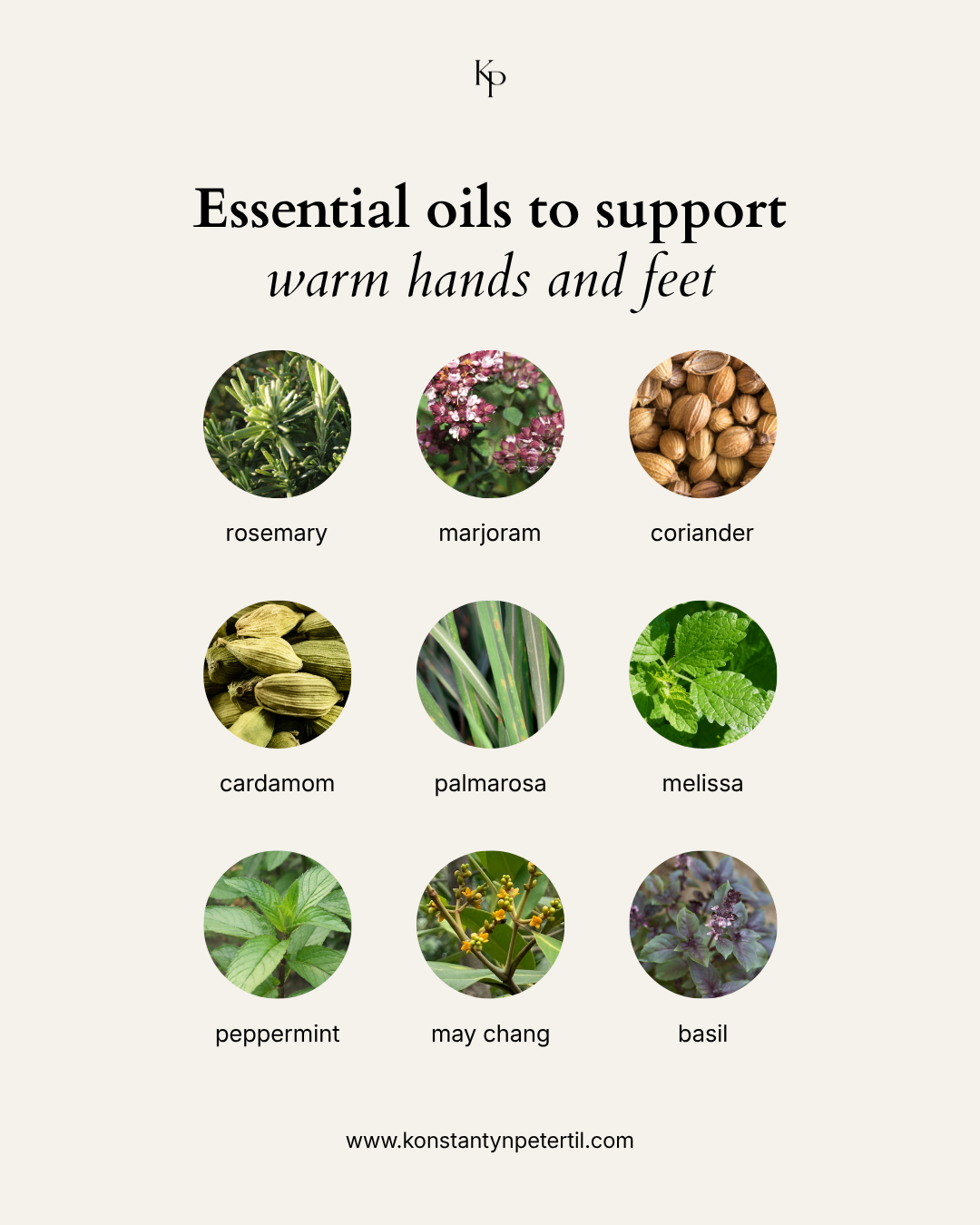
As I said earlier, this list isn’t exhaustive, but I’m pretty sure it gives you a solid foundation for creating warming, circulation-supportive blends. Think of it as a toolbox: pick the oils that fit your needs, your skin, and the aroma you actually enjoy.
And honestly, once you understand a bit of the chemistry behind them, aromatherapy becomes so much easier, and definitely more fun. So don’t be afraid to use this knowledge and play with it!
A practical blending guide for cold hands and feet
Now let’s put everything into practice. I want us to focus not only on the clinical side, but also on creating a genuinely pleasant aroma that feels comforting and becomes a part of your routine.
Below you’ll find three master blends I tested myself while searching for my own ultimate warming blend. I had a great experience with each of them, and I hope you’ll enjoy them too. At the same time, I really encourage you to play and create your own aromatic compositions. Use the ingredient lists from the previous section and let yourself experiment; you might come up with something fabulous.
Each of the formulas below is written for 100 drops, which makes it easy to convert them into percentages if you ever want to scale your batch. A 100-drop blend is just slightly under 5 ml, so if you follow the quantities as written, a 5 ml amber bottle will be the perfect size.
Blend 01
Winter conservatory
Green-herbal, bright, and gently stimulating. Inspired by Victorian conservatories filled with rosemary, mint, and citrus pots brought indoors for the colder months.
Contains mint oils, which can be stimulating. Avoid using on children under 6. Melissa and rosemary may cause skin sensitivity in some people, so patch testing is advised. Avoid during the first trimester of pregnancy. Not recommended for individuals with epilepsy due to rosemary ct. cineole.
Blend 02
Hearthlight
Warm, comforting, and slightly spicy, with a soft floral lift. A quiet evening formula, more soothing than stimulating, with a gentle warming undertone.
Geranium and May Chang can be sensitising when oxidized. Not recommended during the first trimester of pregnancy. Geranium may interact with some medications, including mild anticoagulant considerations; use mindfully if you are taking blood thinners.
Blend 03
Night garden
Dark green, soft citrus shadows, refined and slightly mysterious. A dusk-themed blend inspired by quiet botanical gardens after sunset, made to feel soothing, elegant, and subtly warming.
Eucalyptus, Basil ct. cineole, and Spearmint should not be used on young children. Melissa can be sensitising on some skin types, so patch testing is advised before wider use. Not recommended during the first trimester of pregnancy.

How to use warming blends for best results
To turn any of the master blends into a massage oil, simply dilute them in your chosen carrier.
My personal favourite is Sesame oil (Sesamum indicum), traditionally used in Ayurvedic warming treatments. Choose the unrefined version for the nutty aroma or a refined one if you prefer something neutral.
For hands and feet, a 2–3% dilution works well (about 6–9 drops of master blend per 10 ml of carrier; if your skin is sensitive, start with a lower dilution).
Apply after a bit of warmth, like a shower, bath, or even holding a warm mug, to help the vessels open naturally. Massage for 20–30 seconds to encourage microcirculation; the warming effect is surprisingly long-lasting and can stay noticeable for up to 1–2 hours.
After your warming massage, apply a small amount of magnesium chloride gel to the same area and continue massaging. It boosts circulation even further and feels absolutely divine.
You don’t always need to massage, though. On evenings when you’re too tired, you can simply use the blend by inhalation. I often place a drop or two on a tissue and keep it beside my pillow, which is an effortless way to enjoy the aroma and relaxation.
Using the oils in the evening can be especially comforting if cold feet interfere with falling asleep. And as always, consistency matters more than intensity.
Conclusion
Cold hands and feet can be frustrating, uncomfortable, and honestly a little discouraging on long winter days. But understanding what’s happening in the body makes it so much easier to support yourself in a simple, natural way. Once you know how certain aromatic compounds relax smooth muscle and encourage healthy blood flow, essential oils become not just “nice smells,” but a meaningful part of your self-care toolkit.
Whether you decide to use the ready-made blends from this article or create something entirely your own, the most important thing is finding an aroma that feels comforting, familiar, and enjoyable. That’s when aromatherapy becomes a routine you actually look forward to, not another task on your list.
Take your time, explore the oils you’re drawn to, and let this be a small ritual of warmth during the colder months. And who knows… your perfect warming blend might end up being just a few drops away.

References
Amato, A., Liotta, R., & Mulè, F. (2014). Effects of menthol on circular smooth muscle of human colon: Analysis of the mechanism of action. European Journal of Pharmacology, 740, 295–301. https://doi.org/10.1016/j.ejphar.2014.07.018
Devi, R. C., Sim, S. M., & Ismail, R. (2011). Spasmolytic effect of citral and extracts of Cymbopogon citratus on isolated rabbit ileum. Journal of Smooth Muscle Research, 47(5), 143–156. https://doi.org/10.1540/jsmr.47.143
de Menezes-Filho, J. E., Gondim, A. N., Cruz, J. S., de Souza, A. A., Santos, J. N., Conde-Garcia, E. A., de Sousa, D. P., Santos, M. S., de Oliveira, E. D., & de Vasconcelos, C. M. (2014). Geraniol blocks calcium and potassium channels in the mammalian myocardium: Useful effects to treat arrhythmias. Basic & Clinical Pharmacology & Toxicology, 115(6), 534–544. https://doi.org/10.1111/bcpt.12274
Gonçalves, T., Almeida, A., Pontes, L., Oliveira, J., Feitosa, M., Júnior, J., Veras, R., & Medeiros, I. (2025). Monoterpenes in vascular function: A review of bioactivity and mechanisms of action. International Journal of Molecular Sciences, 26(18), 9243. https://doi.org/10.3390/ijms26189243
Hashimoto, M., Takahashi, K., & Ohta, T. (2023). Inhibitory effects of linalool, an essential oil component of lavender, on nociceptive TRPA1 and voltage-gated Ca²⁺ channels in mouse sensory neurons. Biochemistry and Biophysics Reports, 34, 101468. https://doi.org/10.1016/j.bbrep.2023.101468
Heghes, S. C., Vostinaru, O., Rus, L. M., Mogosan, C., Iuga, C. A., & Filip, L. (2019). Antispasmodic Effect of Essential Oils and Their Constituents: A Review. Molecules (Basel, Switzerland), 24(9), 1675. https://doi.org/10.3390/molecules24091675
Leal-Cardoso, J. H., Lahlou, S., Coelho-de-Souza, A. N., Criddle, D. N., Pinto Duarte, G. I., Santos, M. A., & Magalhães, P. J. (2002). Inhibitory actions of eugenol on rat isolated ileum. Canadian Journal of Physiology and Pharmacology, 80(9), 901–906. https://doi.org/10.1139/y02-117
Oz, M., El Nebrisi, E. G., Yang, K. S., Howarth, F. C., & Al Kury, L. T. (2017). Cellular and molecular targets of menthol actions. Frontiers in Pharmacology, 8, 472. https://doi.org/10.3389/fphar.2017.00472
Souza, F. V., da Rocha, M. B., de Souza, D. P., & Marçal, R. M. (2013). (−)-Carvone: Antispasmodic effect and mode of action. Fitoterapia, 85, 20–24. https://doi.org/10.1016/j.fitote.2012.10.012
Takaishi, M., Fujita, F., Uchida, K., Yamamoto, S., Sawada Shimizu, M., Hatai Uotsu, C., Shimizu, M., & Tominaga, M. (2012). 1,8-Cineole, a TRPM8 agonist, is a novel natural antagonist of human TRPA1. Molecular Pain, 8, 86. https://doi.org/10.1186/1744-8069-8-86
Ventura-Martínez, R., Rivero-Osorno, O., Gómez, C., & González-Trujano, M. E. (2011). Spasmolytic activity of Rosmarinus officinalis L. involves calcium channels in the guinea pig ileum. Journal of Ethnopharmacology, 137(3), 1528–1532. https://doi.org/10.1016/j.jep.2011.08.047
Leave a Reply